
18 Rescued Crew Members from a Burning Cargo Ship Are Delivered to Mangaluru Port by INS Surat
Following a cargo ship fire off the western coast of India, the guided-missile destroyer INS Surat safely landed 18 rescued crew members at Mangaluru harbor in a amazing showing of the Indian Navy’s sea rescue capabilities and quick response. What could have been a maritime tragedy turned out to be a story of accuracy, bravery, and quick coordination.
A Fire at Sea: The Incident Unfolds
The freighter ship, which is said to be sailing across the Arabian Sea, sent a distress call after fire engulfed the engine compartment of the ship in a massive fire. Soon, the fire spread, jeopardizing the ship’s stability and the lives of all 18 crew members. An important part of the ship was burning, and the likelihood of an explosion was increasing, thus a quick response was necessary.
The Indian Navy responded quickly, always on the lookout for emergencies and threats at sea. INS Surat was ordered right away to approach the damaged ship since it was already in the location on one of its regular patrols.
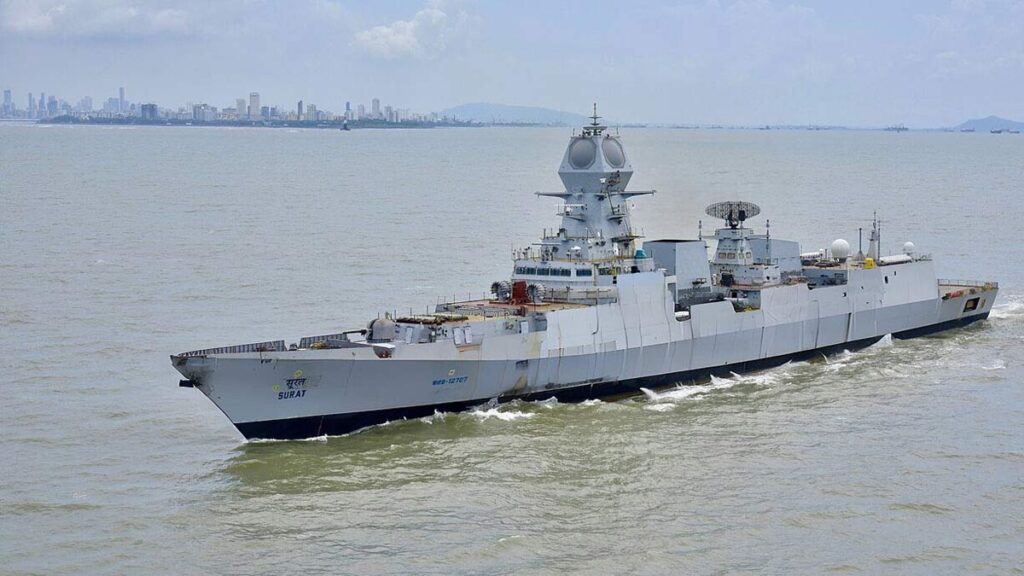
INS Surat: The Guardian in the Blue
Recently commissioned and fitted with cutting-edge equipment, INS Surat is one of India’s cutting-edge frontline warships. Stealth capabilities and It is a powerful tool for humanitarian and disaster relief tasks, and its design integrates modern arsenals.
The moment the ship heard the distress signal, its crew sprang into action. In the face of rising smoke and rough seas, the rescue effort got underway in full force. Lifeboats & expert boarding parties were used to remove all 18 crew members from the swamped ship. Medical teams aboard the INS Surat began treating the rescued crew men shortly after their arrival. Most of the rescued crew members were calm despite being shaken by the ordeal.
A Smooth Return to Shore
After stabilizing the 18 survivors, INS Surat veered off course and headed for Mangaluru, the closest-port. The vessel reached the New Mangalore Port in the early morning hours, where local officials, coast guard officers, and emergency response personnel were waiting for the arrival. At the quayside, there were heartfelt moments of relief and appreciation when the relatives of the rescued sailors were further told.
The rescued peoples, who were mostly from Southeast Asia and India, were then sent to hospitals in the location for in-depth medical testing and therapy. Overall, they were incredibly relieved and thanked the Indian Navy for what many called a “miraculous rescue.”
Navy’s Role in Non-Combat Missions
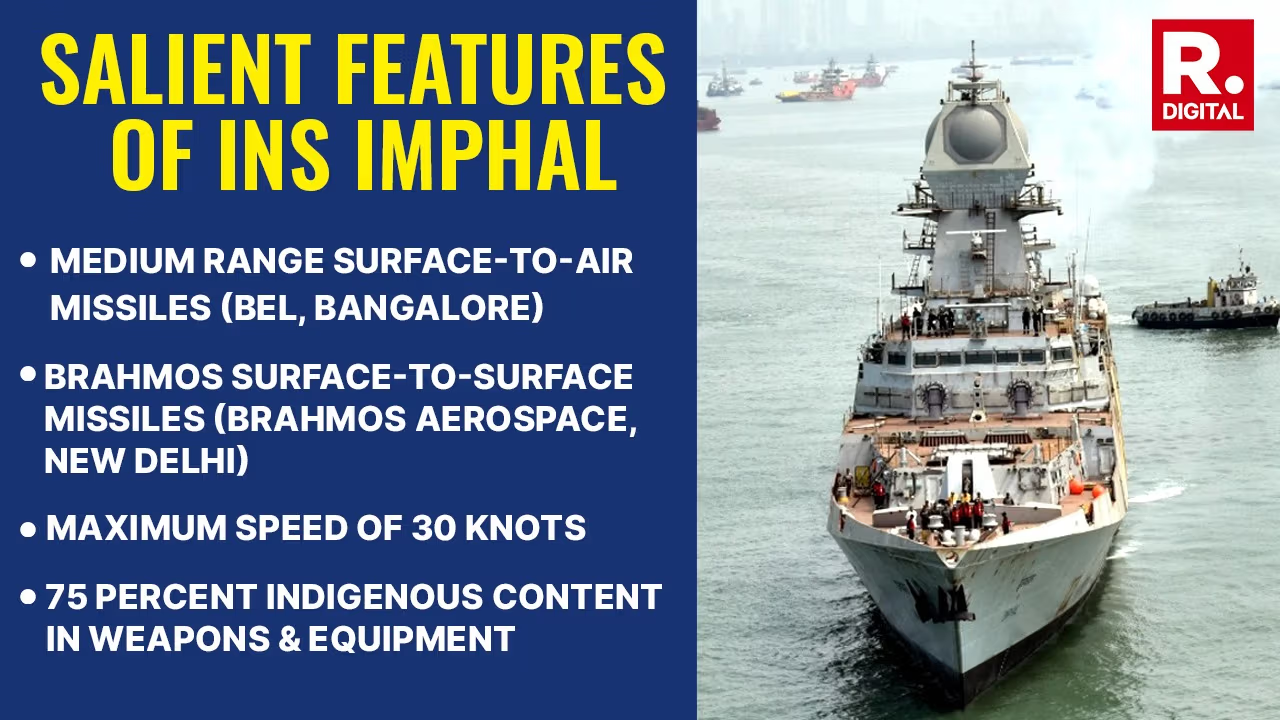
The Indian Navy’s extending role in peacetime operations is reflected in this rescue effort. Although traditionally regarded when a naval force constructed for national defense and security, the Navy is increasingly assuming roles in humanitarian aid, search and rescue (SAR) operations, and natural disaster relief.
Over the past decade, the Indian Navy has successfully carried out several similar missions — from evacuating Indian citizens during international crises to aiding foreign vessels in distress. This specific rescue strengthens India’s reputation while a responsible maritime power in the Indian Ocean location and adds another feather to its cap.
Collaboration Across Agencies
What made this rescue especially efficient was the seamless coordination between different agencies. In order to redirect the distress call and direct naval forces to the location, the Mumbai-based Maritime Rescue Coordination Centre (MRCC) played a crucial role. When the survivors arrived, the Indian Coast Guard helped with logistics, and port-officials made sure that the docking process was quick and safe.
Such inter-agency cooperation is important in emergency maritime responses, especially while commercial maritime traffic continues to increase in volume and complexity.
Crew Safety and Preparation under the Spotlight
The incident emphasizes the importance of safety measures on commercial ships, even though the successful rescue is commendable. According to early reports, the cargo ship’s fire was unexpected, but the crew complied with protocol by quickly sending out an SOS and making an effort to extinguish the fire.
This emphasizes the importance of continuous training, maintenance of equipment, and drills for preparedness onboard ships, especially those crossing international seas. This tragedy may serve to be a reminder to the shipping industry, powers, and marine schools to reevaluate their safety preparedness plans.
The Human Side of the Story
It is impossible to ignore the affects on the mind on participants in addition to the operational success and tactical efficacy. Some of the crew members were said to have wept upon reaching Mangaluru. Survivors talked about experiencing moments of fear and hope, and then relief, and many were quick to commend the professionalism and understanding shown by INS Surat’s crew.
We seemed to be in a death trap. The smoke was all around us, and we did not know how long the ship would last,” added a crew member. “When we saw the naval ship, we knew that we had a second option.”
A Maritime Nation with a Humanitarian Heart
In recent years, India’s maritime policy has evolved to prioritize stability, safety, and security over regional waters. The Navy’s role to be a military force and humanitarian force that protects lives and provides help when important is reaffirmed by such actions.
India is happy of the successful rescue of INS Surat, showing its seafaring humanism in addition to its strength in arms. It sends a powerful message: in crisis to be in conflict, India’s naval community is ready, able, and deeply committed to rescuing itself.
These operations highlight the importance of consistent investment in rescue capability, cutting-edge naval technology, and international cooperation on maritime safety in-light of increasing marine traffic and changing problems.