
On what ought to have been a celebratory note, biotech businessman and ex-U.S. presidential hopeful Vivek Ramaswamy was at the heart of a furore of online outrage. His wedding anniversary message with wife Apoorva Tewari Ramaswamy elicited an avalanche of racist and xenophobic abuse, laying bare a wider current of annoyance related to persistent H-1B visa controversy and the wider debate concerning immigration in America.
A Personal Milestone Turned Political Lightning Rod
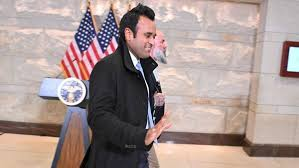
Ramaswamy, known for his right-leaning, anti-woke rhetoric and 2024 Republican presidential run, posted a heartfelt tribute to his wife on social media in May 2025, celebrating years of partnership, family, and shared values. Accompanied by a candid photo, the post was simple in tone—an expression of personal gratitude and love.
But within a matter of hours, it was deluged with nasty remarks. A heartwarming moment was turned into an opportunity for racist and anti-immigrant diatribes, with critics attacking him as well as his Indian-American heritage. Many of the critics pointed to his background, reasoning that he “doesn’t belong” to American political life, while others equated his heritage with contentious immigration policies such as the H-1B visa program.
Why the H-1B Visa Controversy Matters
The H-1B visa program, under which American firms may hire foreign professionals in specialized industries like IT, engineering, and biotech, has been a lightning rod for American politics for years. Critics claim that it displaces local workers and holds down wages, while its defenders say it is necessary to fill essential skill shortages and spur innovation.
Ironically, Ramaswamy himself had earlier been a vociferous critic of H-1B abuse, even while he had himself employed H-1B employees in his biotech businesses. While on the campaign trail in 2024, he had decried the visa system as “a form of indentured servitude” and promoted a merit-based immigration system.
This seeming contradiction rendered him a lightning rod for criticism—both from anti-immigrant elements and from immigrant groups who felt betrayed by one of their own.
The Online Firestorm
The reaction to his anniversary message was not only political; it was personal and racially charged. Responses ranged from subtle dog-whistling to full-blown racism, with users questioning his Americanness, ridiculing his appearance, and playing off stereotypes about Indian immigrants.
Among the most prevalent themes were:
Charges of dual allegiance or cultural incompatible
Derision of Indian accents, names, and customs
Assertions that “real Americans” were being displaced by immigrants such as himself
Several commenters also pulled his wife, Apoorva, into the fray, despite her professional status as a respected physician and Yale graduate. The couple, who are parents, found themselves the reluctant poster family for America’s cultural and political divide on race and immigration.
The Reaction: Support and Condemnation
Following the outrage, several prominent individuals from politics and culture demonstrated their support for Ramaswamy and condemned the racist language. Indian-American politicians, tech leaders, and civil rights groups criticized the attacks and demanded greater accountability online.
Still, Ramaswamy’s critics continued to speak out, and some attacked him for helping to fuel the same brand of nationalism that eventually turned on him. “You can’t play with fire and then be surprised when you get burned,” one liberal pundit tweeted, pointing to Ramaswamy’s own efforts to fan the flames of culture wars throughout his campaign.
Conversely, the proponents opined that nobody, independent of their political beliefs, should have to endure racial insults and xenophobic bigotry for merely having a shared milestone in common.
A Mirror to America’s Culture War
The episode reveals a profound fault line in American society—where identity, politics, and immigration intersect. For Indian-Americans such as Ramaswamy, the backlash highlights an uncomfortable truth: succeeding, being conservative, and being outspoken does not inoculate against racism. In fact, it might even amplify scrutiny from both sides of the political divide.
It also illuminates how tensions surrounding immigration are becoming more personalized. The H-1B visa controversy no longer remains an issue in policy circles alone; it has penetrated social media, wedding parties, and personal conversations.
Ramaswamy’s bid to redefine the conservative movement by introducing “non-traditional voices” now appears contradictory to the pushback he’s garnering from the same network.
The Broader Indian-American Experience
The attack also sets off a wider debate on the Indian-American identity in America. Even though one of the best-educated and economically successful diaspora communities, Indian-Americans end up being caught between their cultural pride and prejudice in society.
American politicians of Indian descent, ranging from Nikki Haley to Kamala Harris, have faced varying degrees of scrutiny and exoticization. Ramaswamy’s experience puts another chapter in this on-going saga in mind, recalling that “model minority” status does not necessarily imply acceptance—particularly when political allegiances change.
What Comes Next?
Although Ramaswamy has not made a direct statement against the racist backlash, people close to him indicated that he’s “undeterred and thinking about upcoming projects,” perhaps referring to a comeback to the tech or political arena.
This event may shape Indian-American leaders’ approach to public conversation in the future. Will they keep trying to participate in conservative politics at the risk of being excluded? Or will this mark a change toward more inclusive coalitions against racism and xenophobia, party lines aside.
Final Thoughts
Although Vivek Ramaswamy’s anniversary post has the potential to spark a nasty internet conflict, it also sparks a much-needed conversation about immigration, identity, and the American Dream. In an era where culture wars occupy headlines, even private celebrations are not exempt from political weaponization.
The reaction says as much about America’s still-unresolved issues with race and immigration as it does about Ramaswamy himself. But it is also a warning—both to public and private citizens—about the need to do more to defend our common humanity from online hate.