
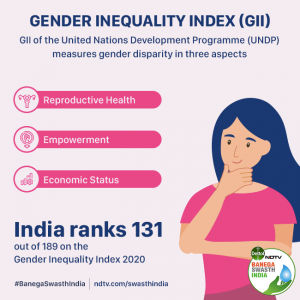
India is ranked 131 between 148 countries, with a score for gender equality of 64.4%—a growth increase over the year before, but a drop in rank from 129th position in 2024.This indicates that while India registered marginal absolute improvements, other countries made massive strides.
What is the Index?
The Global Gender Gap Index, created by the World Economic Forum, measures gender equality on four pillars:
Economic Participation & Opportunity
Educational Attainment
Health & Survival
Political Empowerment
Across the world, the index measured the average gender gap that was closed by 68.8%—the highest ratio of progress in a year since the COVID‑19 crisis. However, based on this pace, complete gender equality is still more than a century away
Pillar-Wise Performance: More Progress, Persistent Fragility
1. Economic Participation & Opportunity
India rose from 39.8% to 40.7%, due mainly to increasing equality in estimated income—from 28.6% to 29.9%
India’s record-high female labor force participation ratio of 45.9% persisted.
Why it matters: But this still leaves more than 60% of the gender gap open—to barriers in labour-force inclusion, unequal pay, and thin ranks in top jobs.
2. Educational Attainment
Gained ground due to increases in female literacy and university signing up, earning 97.1%. Although caste and rural-urban inequities still exist, this is India’s best-performing sector.
3. Health & Survival
Achieved a healthy life expectancy, a better sex ratio, and 95.4–95.5% equality.
But the achievements are partly because male life expectancy is falling even to be absolute health results are improving.
4. Political Empowerment
Slipped slightly from 25.1% to 24.5%, with women’s representation in Parliament falling from 14.7% to 13.8%, and ministerial representation from 6.5% to 5.6%.
Remains India’s weakest pillar, signifying underrepresentation in policymaking circles.
Regional & Global Context
Among South Asian countries, India is at or close to the bottom of the list, lagging behind Bangladesh (24th in the world), Nepal (125th), Sri Lanka (130th), Bhutan (119th), and even Maldives (138th).
Globally, Iceland tops the index, while Finland, Norway, the UK, and New Zealand are continuously the best achievers.
Why India’s Rank Fell—Despite Score Gains
Relative decline: India’s small +0.3 gain was outpaced by more rapid gains elsewhere.
Political slowdown: The decline in Parliament & cabinet seats for women indicates stagnation in gender-sensitive reforms.
Top Structural Barriers in India
Patriarchal norms & gender stereotypes, especially in rural communities, affect girls’ education and women’s autonomy
Labor force issues: Indian women carry close to 10× more unpaid care labor and experience wage discrimination on a daily basis
Political marginalization: Women are confronted by violence, literacy restrictions, and economic barriers to discourage political engagement
Low-Equity in Pay: Even educated women tend to do less paid or informal employment to be a result of prejudices & absence of chance.
Path Forward: How India Can Get Back on Track
1. Mobilize Women’s Workforce Inclusion
Invest in low-cost childcare and flexible work practices.
Empower women in STEM and high-growth industries.
Use compliance inspections to enforce equal wages for equal labor.
2. Increase Political Empowerment
Enact women’s reservation in Parliament and Panchayats.
Provide leadership training, security features, financial help, and areas free from harassment.
3. Encourage Social Awareness
Conduct ongoing campaigns to change patriarchal mindsets—starting with parents, teachers, and employers.
Involve community leaders to resist gender variables in education and employment.
4. Increase Legal & Policy Support
Strengthen and enforce gender-neutral laws in land rights, domestic violence, and place of work equality.
Ensure smooth implementation of schemes like Beti Bachao Beti Padhao, scholarship programs, and One-Stop Centers
5. Monitor & Evaluate Progress
Use public dashboards and gender-disaggregated data to track improvements in pay, leadership roles, and political representation.
Establish-interim aim—e.g., close the Economic Participation gap by 20% over five years.
Why It Matters: Gender Equality Is Smart Economics
Increased female participation may greatly increase GDP and development.
More gender equality countries are stronger and wealthierWomen empowerment is critical to the attainment of sustainable development goals and inclusive growth.